How to Tie the Uni Knot (and Why Every Angler Needs It)
The uni knot step by step: one knot to tie hooks and swivels, attach line to the reel spool, and build the double uni line-to-line connection.
If you could only learn one knot for every job, the uni knot would be a strong candidate. It ties line to hooks, lures and swivels, attaches line to a reel spool, and, tied twice, joins two lines together. It works with monofilament, fluorocarbon and braid, and it seats easily even in heavier line. That is why it is often called the universal fishing knot. This guide shows you how to tie a uni knot step by step and how to use it in every part of your rig.
What the uni knot is used for
- Tying hooks, lures and swivels to any type of line.
- Tying line to the reel spool (an arbor knot alternative) when you spool a spinning reel.
- Joining two lines, braid to leader or mono to mono, as the double uni knot.
- Making a loop: if you stop before sliding the knot down to the eye, the uni becomes a loop knot that lets lures swing freely.
Why anglers love the uni knot
- One method, many jobs. Learn it once and use it everywhere.
- Reliable with heavier line. Thick fluorocarbon leaders that are hard to seat in a clinch knot pull down neatly in a uni.
- Good with braid when you add a few extra wraps.
- Easy to tie in poor conditions, with cold hands or at night.
How to tie the uni knot
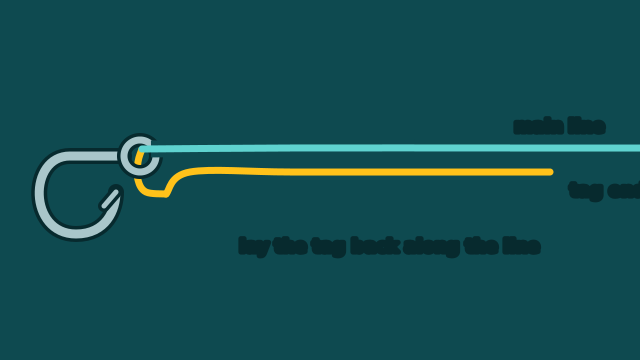
Pass 15 to 20 cm of line through the eye of the hook or swivel and lay the tag end back alongside the main line.
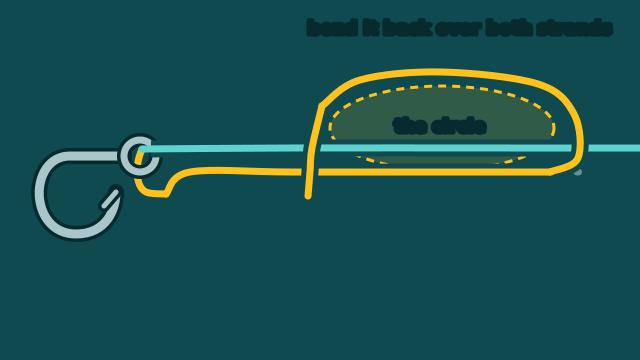
Bend the tag end back toward the eye to form a circle lying over the two parallel strands.
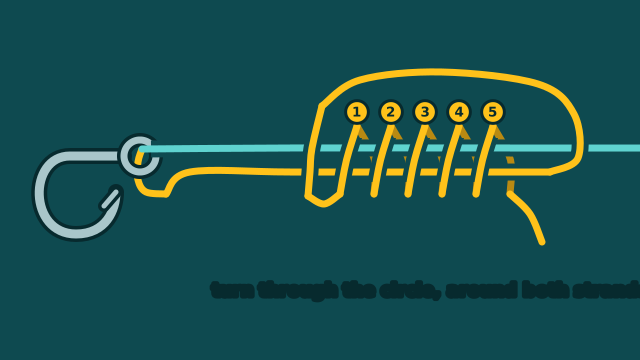
Wrap the tag end through the circle and around both strands 5 to 7 times, working away from the eye.
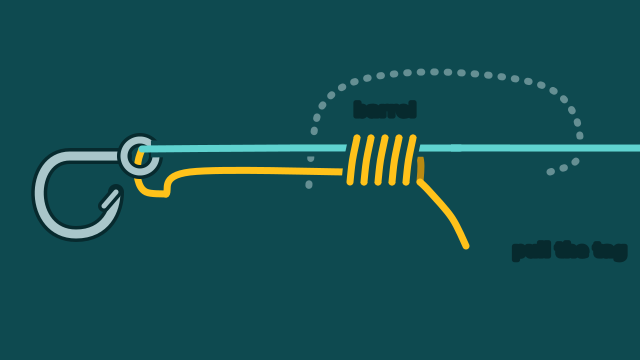
Wet the line and pull the tag end to snug the wraps into a neat barrel.
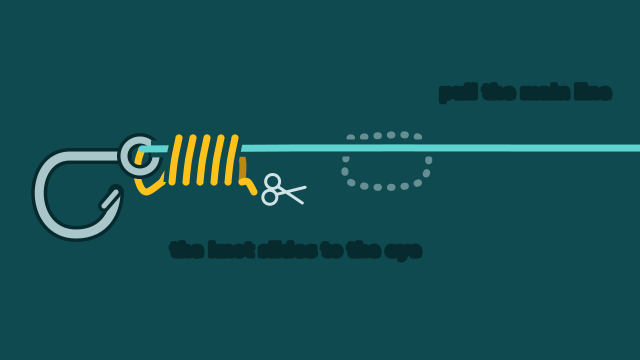
Pull the main line to slide the knot down tight against the eye, then trim the tag end.
How many wraps?
- Monofilament and fluorocarbon, light to medium: 5 to 6 wraps.
- Heavy fluorocarbon leaders (40 lb and up): 3 to 4 wraps, because thick line will not seat with many wraps.
- Braid: 7 to 10 wraps, because braid is thin and slippery.
Tips for a strong uni knot
- Wet the wraps before tightening, every time.
- Snug the knot first, then slide it. Pull the tag end to form a neat barrel of wraps, then pull the main line to slide the knot down onto the eye.
- Seat it firmly against the eye. A knot left partway up the line acts as a loop and can slip under heavy load unless you meant it as a loop knot.
- Trim, but not flush. Leave about 3 mm of tag.
The uni knot as a loop knot
Lures such as jerkbaits, small swimbaits and topwater lures swim better when they can move freely on the line. To make a uni loop, tie the knot as normal but stop before sliding it to the eye: pull the tag end tight to lock the wraps while leaving a small loop of 5 to 10 mm. Under a big fish, the loop may close up against the eye, which is fine.
Tying line to the reel spool
- Open the bail and pass the line around the spool.
- Tie a uni knot around the main line with 3 to 4 wraps.
- Slide the knot down to the spool and pull tight, then trim the tag.
On a smooth spool with braid, put a few metres of mono backing on first, or a strip of tape, so the braid cannot slip.
Uni knot vs other knots
- Versus improved clinch knot: both are great for hooks on mono. The uni seats better in heavy line and also joins lines; the improved clinch is slightly faster for small hooks.
- Versus Palomar knot: the Palomar is very strong with braid but awkward with big lures. The uni handles any lure size.
- Versus FG knot: for joining braid to a leader, the FG knot is slimmer and stronger through rod guides, but the double uni is much faster to tie.
Where the uni knot fits in your rig
A typical saltwater setup might use:
- A uni knot to tie braid to the spool.
- A double uni (or FG) knot to join braid to a fluorocarbon leader.
- A uni knot to tie the leader to a swivel, hook or lure.
That means one knot method covers almost the whole outfit. Pair it with the right hooks from types of fishing hooks and the right swivels from sinkers, swivels and terminal tackle.
Common mistakes
- Wrapping only around one strand. The tag must wrap around both parallel strands inside the circle.
- Too many wraps with heavy line, leaving a lumpy knot that will not seat.
- Not sliding the knot all the way down when you want a tight connection.
- Tying it dry.
Practise until it is automatic
Tie it twenty times at home with heavy cord and a large swivel, then with your real line. Once your fingers know the movements, you can tie it in the dark, which is often exactly when you need it.
Knots and drag
A uni knot tied well keeps a high percentage of the line's strength, but every knot is a potential weak point. Set your drag to protect your weakest link using our reel drag guide.
Identify your catch with ReelScan: snap one photo to get the species, size and safety notes, and earn points. Scan a fish.
One knot, every catch recorded
The uni knot keeps your whole rig together. ReelScan keeps your whole season together: photograph each catch with your camera, get the species, size range and safety notes in seconds, and earn points that grow with size and rarity. Your catches stay in your profile, ready to share with the community.
Summary
The uni knot ties hooks, lures and swivels, attaches line to the spool, makes a loop for lures and joins two lines as a double uni. Lay the tag back alongside the line, form a circle, wrap inside it around both strands, snug the barrel and slide it down. Use fewer wraps with heavy line and more with braid, wet it every time, and test it before you fish.