How to Tie the FG Knot: The Slim, Strong Braid-to-Leader Knot
The FG knot step by step: the thinnest, strongest braid to fluorocarbon leader connection, ideal for casting lures and jigging.
The FG knot is widely regarded as the best braid to fluorocarbon leader connection for casting and jigging. It is extremely slim, so it slides through rod guides without catching, and it is among the strongest line-to-line knots you can tie. The trade-off is that it takes a little practice. This guide shows you how to tie the FG knot step by step, explains why it works, and gives the tips that make the difference between a knot that holds and one that slips.
Why anglers choose the FG knot
- Very slim profile. There is no bulky barrel of wraps, so the knot passes smoothly through the guides when you cast. This lets you use a long leader that sits inside the reel, which is important for casting lures and for vertical jigging.
- Very strong. The braid grips the leader along a long section, a bit like a woven finger trap, so the load is spread out rather than concentrated at one point.
- Excellent with big strength differences, such as 20 lb braid to 40 lb fluorocarbon, or 50 lb braid to 100 lb leader.
How the FG knot works
Instead of tying the leader in a knot, you weave the braid around the leader with many alternating wraps. When you pull hard, the wraps tighten around the leader and bite into it. The harder the fish pulls, the tighter the grip. Half hitches then lock the end of the woven section so it cannot unravel.
How to tie the FG knot

Hold the braid tight under tension: pinch it in your teeth or wrap it around a fixed object, with the rod side tensioned.
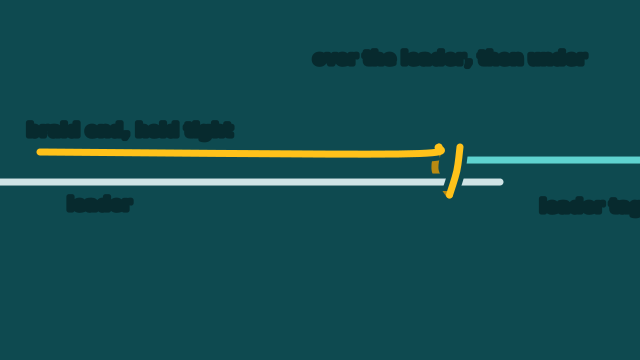
Lay the leader across the braid and make the first wrap: the braid crosses over the leader, then under it.
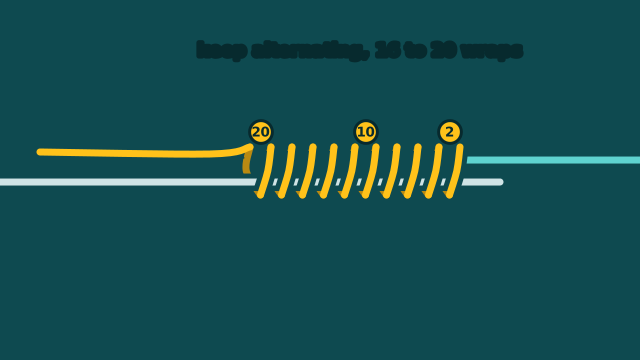
Continue alternating wraps, over then under, around the leader. Make 16 to 20 single wraps so they bite like a woven finger trap.
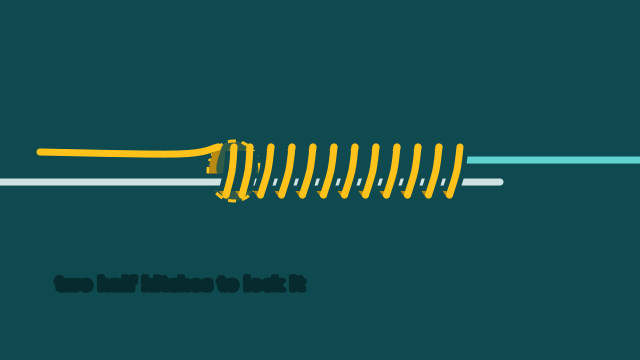
Lock the wraps with two half hitches of the braid around both the braid and the leader.
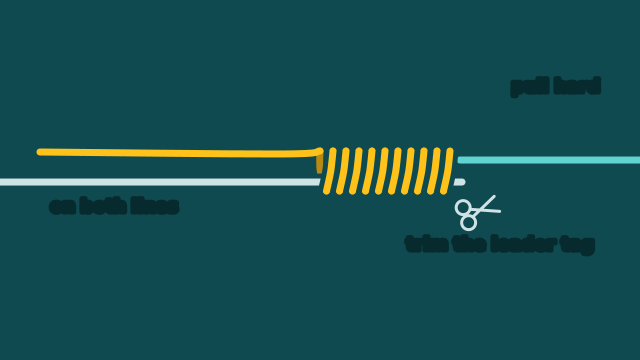
Wet the knot and pull hard on the main braid and the leader to seat the wraps. Trim the leader tag end.
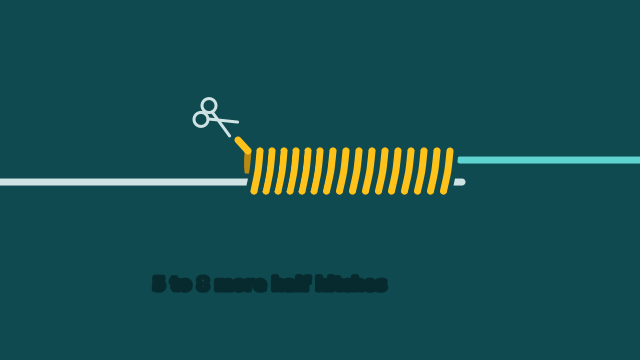
Finish with 5 to 8 more half hitches of braid over the leader, then 2 around the braid alone, and trim.
The key to a good FG knot: tension
The most common reason an FG knot slips is not enough tension on the braid while weaving. The braid must stay tight so each wrap sits firmly on the leader.
Ways to keep tension:
- Hold the braid in your teeth and pull with the rod hand.
- Wrap the braid around a fixed object, such as a rod holder or your foot, with the reel locked.
- Let a little line out, close the bail, and use the rod's weight to hold tension.
- Use an inexpensive FG knot tool, which holds the braid tight while you weave.
How many wraps?
- Light braid (10 to 20 lb) to leader: 16 to 20 single wraps (8 to 10 over-and-under pairs).
- Medium and heavy braid: 20 to 26 wraps for extra grip.
- Too few wraps and the knot slips under load; far more than needed adds nothing.
Keep the wraps tight together and close to each other. Gaps between wraps reduce strength.
Seating the knot
After locking with the first half hitches, wet the woven section well and pull hard: braid in one hand, leader in the other, or both lines wrapped around objects. You should see the wraps tighten and slightly change colour or shape as they bite into the leader. This step is what makes the knot strong. If you skip it or pull gently, the knot will slip on the first big fish.
Finishing the knot
After trimming the leader tag, finish with several half hitches of braid over the leader and then two or three around the braid alone. Some anglers finish with a few touches of a lighter or a drop of knot glue on the braid tag; never melt the main line. The finishing hitches protect the end of the knot and give it a smooth taper.
Common mistakes
- Loose braid while weaving, the main cause of slipping.
- Wrapping the leader around the braid instead of the braid around the leader. The braid always does the wrapping.
- Not wetting and pulling the knot hard before finishing.
- Cutting the leader tag too long, leaving a bump that catches guides. Trim it close, about 1 mm, at an angle.
- Too few wraps with light braid.
Test your FG knot
Wrap the braid around one hand (with a cloth or glove) and the leader around the other and pull hard, close to the maximum strength you expect to fish. A well-tied FG knot should hold. If it slips, you have learned something without losing a fish; retie it with more tension and more wraps.
FG knot vs double uni vs swivel
- FG knot: slimmest and strongest; slower to tie. Best for casting and long leaders.
- Double uni knot: quick and reliable, but bulkier through guides.
- Swivel connection: easy, but the swivel cannot go through the guides, limiting leader length. See sinkers, swivels and terminal tackle.
A practical approach: tie FG knots at home before a trip, carry spare pre-tied leaders, and use the double uni if you have to re-rig quickly on the water.
Choosing the leader
The FG knot is only half the connection. Choose leader length and strength to match the fish and conditions using how to choose a fishing leader, then tie your hook or lure to the leader with a Palomar knot or improved clinch.
FG knot in jigging and popping
In heavy jigging and popping for amberjack, giant trevally and tuna, the leader-to-braid knot sees enormous shock loads. The FG knot, tied with heavy braid and many wraps, is the standard choice for these fisheries because it combines strength with a slim profile that does not snag guides during repeated jerks.
Identify your catch with ReelScan: snap one photo to get the species, size and safety notes, and earn points. Scan a fish.
A trophy-proof knot deserves a trophy record
The FG knot is built for the fish of a lifetime. When that fish comes aboard, ReelScan identifies it from one camera photo and records it with points that grow with size and rarity, up to 200 for a real trophy. Show the community what your knot held and see where your catch ranks.
Summary
The FG knot weaves braid around a fluorocarbon leader in tight, alternating wraps, locks them with half hitches and finishes with a smooth taper. Keep the braid under strong tension, use 16 to 26 wraps, wet and seat the knot hard, and trim the leader tag close. It takes practice, but it gives you the slimmest and one of the strongest braid to leader connections in fishing.