How to Tie the Palomar Knot: Strongest Knot for Braid
Learn the Palomar knot step by step, one of the strongest and simplest fishing knots for tying hooks and lures to braid and fluorocarbon.
The Palomar knot is famous for one reason: it is one of the strongest and simplest knots you can tie, and it holds superbly with slippery braided line where many other knots fail. If you fish braid straight to a hook, a jig head or a small lure, the Palomar is the knot to learn. This guide shows you how to tie it step by step, explains why it is so strong, and covers its few limitations.
Why the Palomar knot is so strong
Most knots grip the line with a single strand. The Palomar is tied with a doubled line, so two strands pass through the eye of the hook and two strands take the load. The overhand knot that locks it sits on both strands, and the loop wraps around the hook eye in a way that spreads pressure evenly. The result is a knot that keeps a very high percentage of the line's strength and almost never slips, even with braid.
What to use the Palomar for
- Braided line to a hook, jig head or lure. This is its main strength.
- Fluorocarbon and monofilament in light to medium strengths.
- Drop shot rigs, where you leave a long tag end below the hook to tie on a sinker.
- Swivels and snaps on braid main line.
It is ideal for jigging with braid for species such as amberjack and grouper, and for light lure fishing for seabass and bluefish.
How to tie the Palomar knot
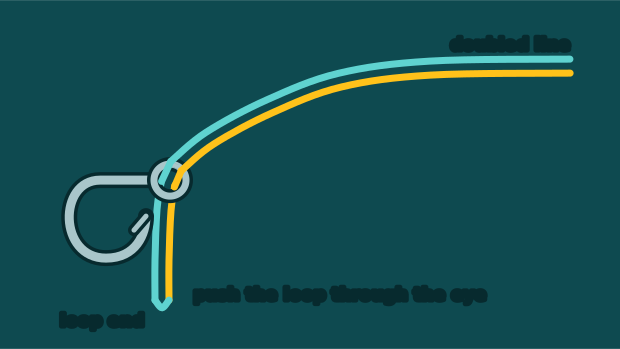
Double about 15 cm of line to form a loop and pass the loop through the eye of the hook or lure.
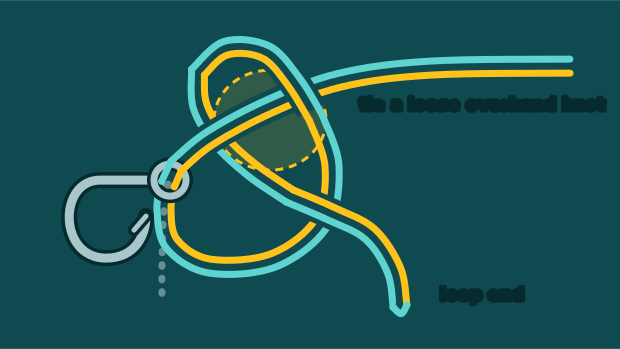
Tie a loose overhand knot with the doubled line, leaving the hook hanging at the bottom of the knot. Do not twist the two strands.
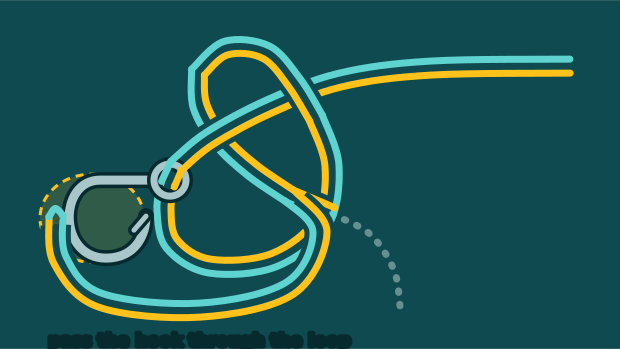
Pass the hook or lure completely through the end of the loop.

Wet the knot, then pull the main line and tag end together while guiding the loop up above the eye.

Trim the tag end, leaving 3 to 5 mm with braid.
Tips for a perfect Palomar knot
- Keep the two strands parallel. If the doubled line twists before you tie the overhand knot, the knot will not seat cleanly and loses strength.
- Leave the overhand knot loose until the hook has passed through the loop. Tightening too early makes it impossible to pass the hook through.
- Moisten and tighten slowly. Pull both the main line and the tag end together, then seat the knot by pulling the main line against the hook.
- Make sure the loop sits above the eye. The loop should close neatly around the top of the hook eye, not slip down the shank.
- Leave a slightly longer tag with braid, around 3 to 5 mm, because braid can creep slightly before it settles.
Limitations of the Palomar knot
- Large lures and treble hooks are awkward to pass through the loop. With big plugs, multiple trebles or long jigs, use a uni knot or an improved clinch knot on fluorocarbon instead.
- Heavy leaders above about 50 lb become stiff and hard to double through small eyes.
- It uses more line than a single-strand knot because you double about 15 cm each time.
Palomar knot vs other knots
- Versus improved clinch: the Palomar is stronger and better with braid; the clinch is quicker with large lures and works well on mono and fluorocarbon.
- Versus uni knot: both are strong; the uni is more versatile because the same knot can join two lines, while the Palomar is more forgiving for beginners with braid.
- Versus loop knots: loop knots let a lure swing freely for more action. Use the Palomar where a tight, strong connection matters more than lure action.
Using the Palomar with a leader
Many anglers now use braid main line with a fluorocarbon leader. In that case, connect braid to leader with a slim knot such as the FG knot or the double uni knot, then use a Palomar or clinch to tie the hook or lure to the leader. Read how to choose a fishing leader for the right strength and length.
If you prefer to fish braid directly to the lure, the Palomar is the best knot for that job, though in clear water a leader will usually get more bites.
The Palomar in a drop shot rig
A drop shot puts the bait above a sinker. Tie the hook with a Palomar knot and leave a long tag end of 30 to 60 cm. Pass the tag end back down through the hook eye from the top so the hook point faces up, then tie a sinker to the end of the tag. It is a great finesse rig for fish holding near the bottom around structure.
Practise and test
Practise the knot at home with a large hook and thick cord until the steps feel natural. With real braid, test the finished knot by pulling hard against a fixed object. A Palomar tied correctly should hold until the line itself breaks.
Knot strength and your drag
Even the strongest knot is part of a system. Set your drag to a safe level for the weakest point, which is often the leader or knot rather than the braid itself. Our guide to setting reel drag shows you how.
Braided line and the Palomar
Braided line has no stretch and a very slick surface, which is why simple knots slip. The Palomar's doubled strands and locking overhand make it one of the few knots braid anglers trust without extra wraps. Learn more about how braid compares with other lines in braid vs monofilament vs fluorocarbon.
Identify your catch with ReelScan: snap one photo to get the species, size and safety notes, and earn points. Scan a fish.
Strong knot, real catch, real points
A Palomar knot gives you confidence when a big fish hits. When you land it, ReelScan identifies the species from a single camera photo, shows its typical and maximum size, and awards points that grow with size and rarity, up to 200 for a trophy. Share the catch and climb the leaderboard.
Summary
The Palomar knot doubles the line through the hook eye, ties a loose overhand knot, passes the hook through the loop and tightens to give one of the strongest connections in fishing. It is the best knot for tying braid to hooks and jigs. Keep the strands parallel, wet the knot and tighten slowly, and use a clinch or uni knot for big lures and trebles.