How to Tie the Trilene Knot: A Strong Hook Knot for Mono and Fluorocarbon
The Trilene knot step by step: a double pass through the eye that keeps up to 90 percent of line strength, when to use it and how to seat it.
The Trilene knot is a strong, reliable knot for tying a hook, swivel or lure to monofilament or fluorocarbon. It was popularised by the line maker that gave it its name, and it is built like a clinch knot with one important difference: the line passes through the eye twice. That double turn spreads the load over more line and protects it from cutting against the metal, which is why the Trilene knot often tests at 85 to 90 percent of the line's rated strength. If you already tie the improved clinch knot, you can learn the Trilene knot in two minutes.
When to use the Trilene knot
- Hooks and swivels on mono and fluorocarbon, especially in the 8 to 30 lb range used for most inshore and pier fishing.
- Fluorocarbon leaders, which are slippery and stiff. The double turn through the eye gives fluorocarbon more to grip.
- Sinkers and swivels on bottom rigs, where a dropped weight would mean a lost rig.
- Bait fishing for fish with hard mouths such as snapper and grouper, where a sudden heavy strike tests the knot at the eye.
It is less suited to very thick lines (above about 50 lb), because two turns of heavy line will not both fit through a small eye. For braid on its own, the Palomar knot is the better choice, because braid can slip in clinch-style knots.
How to tie the Trilene knot
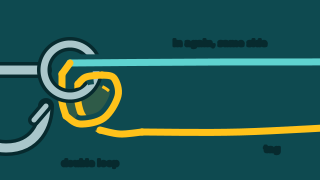
Pass the tag end through the eye, then through it a second time from the same side, leaving a small double loop at the eye.
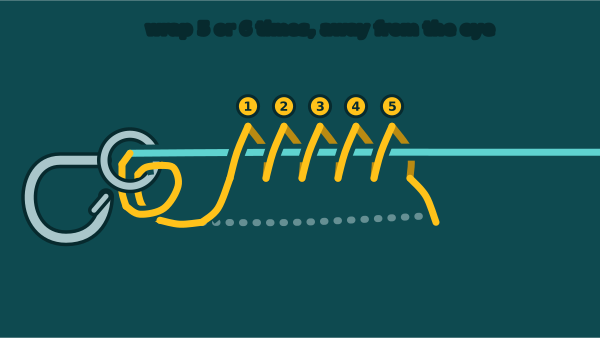
Wrap the tag end around the main line 5 or 6 times, working away from the eye.
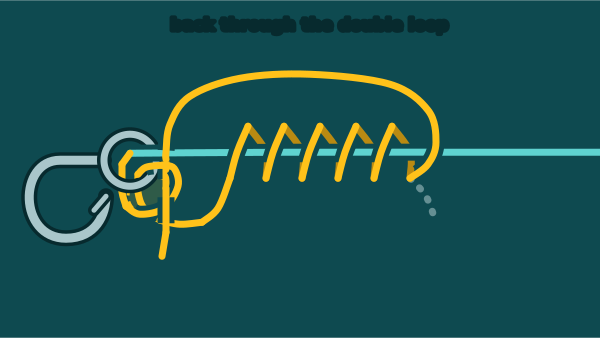
Bring the tag back and pass it through both turns of the double loop at the eye.
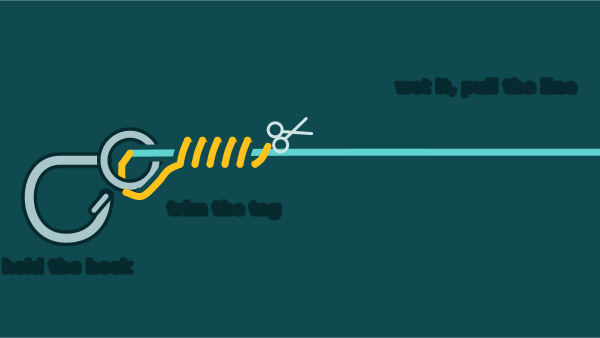
Wet the knot, hold the hook and pull the main line slowly so the wraps seat. Trim the tag to 3 mm.
Why the double turn makes it stronger
A single strand through the eye takes all the load on one small curve. When a fish pulls, that curve is crushed against the metal and heated by friction, and that is where most knots fail. The Trilene knot puts two turns of line around the eye, so the load is shared and the bend is gentler. The wraps then lock the tag against the main line in the same way as a clinch knot.
The most common mistake is to let the two turns cross or twist when you pull the knot tight. Keep a finger in the small double loop while you wrap, and you will see that it stays open and round. When you pass the tag back, it must go through both turns at the eye together, not just one.
How many wraps
- Light line (4 to 12 lb): 6 wraps.
- Medium line (12 to 25 lb): 5 wraps.
- Heavier line (25 to 40 lb): 4 wraps.
More wraps in heavy line do not add strength. They only make the knot harder to seat, and an unseated knot is a weak knot.
Seating the knot
Seating matters as much as the tying. Wet the knot with water or saliva, hold the hook firmly, and pull the main line slowly. You want the wraps to coil down in a neat spiral against the eye, not bunch up or overlap. A sudden yank can heat the line and weaken it before you have even cast. Once it is seated, give it a firm test pull and trim the tag to about 3 mm. A slightly longer tag on fluorocarbon gives a little margin if the knot settles under load.
Trilene knot vs improved clinch knot vs Palomar
- Improved clinch knot: quick and familiar, but a single turn at the eye. Fine for light mono, weaker in fluorocarbon.
- Trilene knot: the same speed, with a double turn at the eye. Stronger, and the better choice for fluorocarbon.
- Palomar knot: very strong and the best for braid, but you have to pass the whole lure through a loop, which is awkward with treble hooks and big lures.
For a fast, strong lure knot in fluorocarbon you can also look at the San Diego jam knot.
Matching the knot to your line
The Trilene knot is at its best with monofilament and fluorocarbon. If you are not sure which line to use for your leader, read the guide to braid, mono and fluorocarbon. When you fish braid as the main line, join it to a mono or fluorocarbon leader first with an FG knot or Albright knot, then use the Trilene knot to tie the leader to the hook.
Tips
- Leave a long enough tag, about 15 cm, so you have room for the wraps and the pass back.
- Wet every knot before you tighten it.
- Keep the double loop open with a finger while wrapping.
- Check the eye for sharp edges or burrs; a rough eye will cut any knot.
- Retie after a big fish or after the line rubs on rocks.
Common mistakes
- Passing through the eye only once, which turns it into a plain clinch knot.
- Letting the two turns at the eye cross or twist.
- Passing the tag back through only one of the two turns.
- Pulling it tight dry, which burns the line.
- Using too many wraps in heavy line.
The Trilene knot is a good "default" knot to learn if you fish mono or fluorocarbon. It is quick to tie, easy to check, and noticeably stronger than a simple clinch.
Identify your catch with ReelScan: snap one photo to get the species, size and safety notes, and earn points. Scan a fish.
Summary
The Trilene knot is a clinch knot with a double turn through the eye, and that small change makes it one of the strongest everyday knots for mono and fluorocarbon. Tie it with 4 to 6 wraps, pass the tag back through both turns, wet it and pull slowly. For braid, use the Palomar; for joining lines, see the leader guide.