How to Tie a Surgeon’s Loop: The Quickest Fixed Loop
Tie the surgeon’s loop to make a fixed loop at the end of a line in seconds: for loop-to-loop leaders, sinkers and rigs.
The surgeon's loop is the quickest way to make a strong, fixed loop at the end of a line. It is simply a double overhand knot tied in a doubled section of line, so if you can tie an overhand knot, you can tie a surgeon's loop in a few seconds. It is used for loop-to-loop connections, for attaching sinkers and swivels, and for building simple rigs. It is not the slimmest loop knot, but for speed and reliability it is hard to beat.
When to use the surgeon's loop
- Loop-to-loop connections, for example joining a leader to a main line that already has a loop.
- Attaching a sinker with a quick loop you can pass through the eye of the weight.
- Making the end loop on a rig, such as the bottom of a paternoster rig.
- Quick repairs on the water, when you need a loop now and do not have time for something more complex.
For a loop that stands out from the middle of the line to hold a hook, use the dropper loop knot instead. For a loop that lets a lure swing freely, the non-slip loop knot is better, because it is tied directly to the lure eye.
How to tie the surgeon's loop
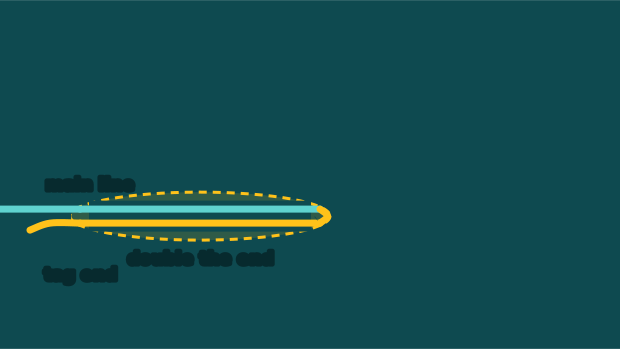
Double the end of the line back on itself to make a doubled section long enough for the loop and the knot.
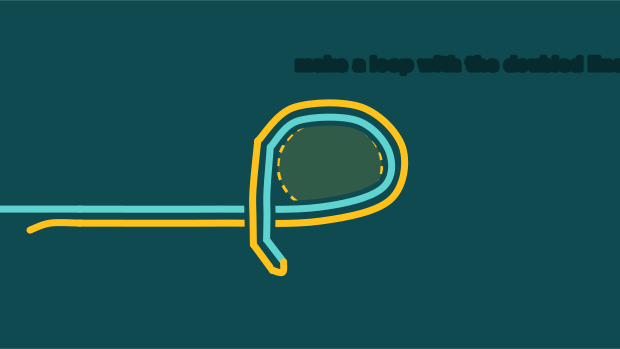
Make a loop with the doubled line, laying it over itself.
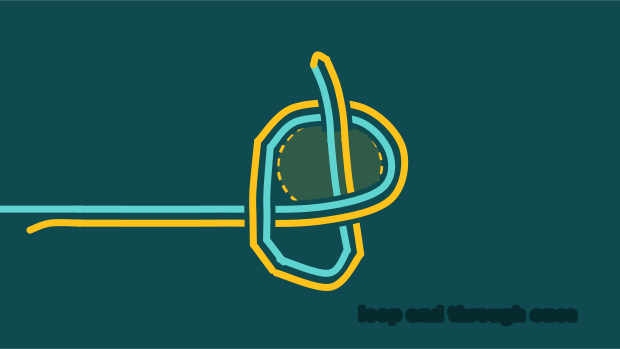
Pass the loop end through that loop once, as if tying an overhand knot.
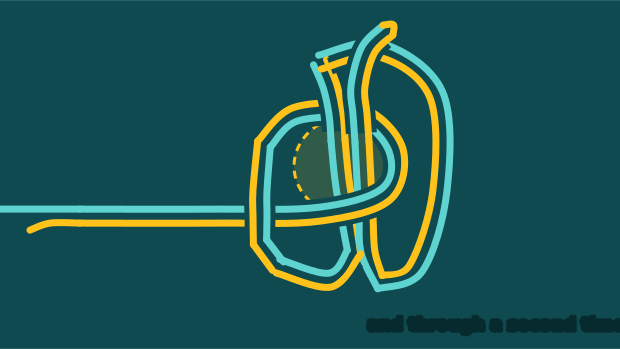
Pass it through a second time to make a double overhand.
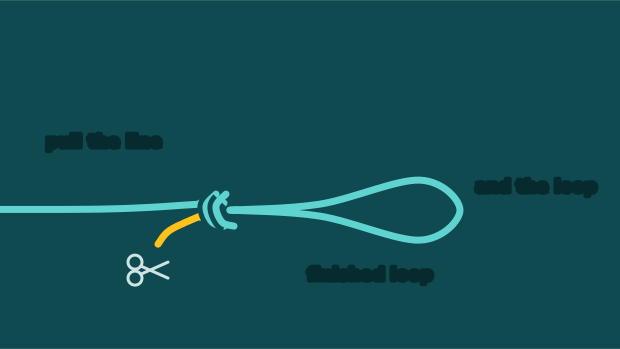
Wet it, pull the loop and the main line hard in opposite directions, and trim the tag.
Why the second pass matters
A single overhand knot in doubled line makes a loop, but it can slip and it weakens the line sharply. The second pass turns it into a double overhand, which grips far better and spreads the strain over more line. Some anglers add a third pass for very slippery line such as fluorocarbon; this is sometimes called a triple surgeon's loop.
Keep the two strands of the doubled line side by side and untwisted while you tie. If they twist around each other, the knot seats unevenly and loses strength.
Controlling the loop size
The loop size is set by how much line you double back before tying. Make the doubled section a bit longer than the loop you want, because the knot itself uses some of it. Before you pull the knot tight, you can slide it up or down to adjust the loop. Once it is seated, the size is fixed.
Seating the knot
Wet the knot. Hold the loop in one hand and both the main line and the tag in the other, and pull in opposite directions. Then pull the main line and the loop firmly to finish seating it. Trim the tag, leaving 2 to 3 mm.
Surgeon's loop vs other loops
- Surgeon's loop: the fastest fixed end loop; a little bulky.
- Perfection loop: slimmer and sits in line, but harder to learn.
- Bimini twist: a long, very strong double line for offshore fishing, rather than a small loop.
- Dropper loop knot: a loop in the middle of a line, standing out to the side.
Using it for loop-to-loop connections
Loop-to-loop connections let you change leaders quickly without retying a knot to the main line. Tie a surgeon's loop in the end of the leader and another (or a stronger loop) in the main line, then pass one loop through the other and pull the whole leader through. When done correctly, the two loops lock together like a reef knot. If they slide over each other to form a "girth hitch" that cuts in, undo it and connect them again.
Line types
The surgeon's loop works well in monofilament and fluorocarbon. In braid, it can be used, but braid is slippery and the knot is more likely to slip, so a third pass and careful seating are important. For connecting braid to a leader, the FG knot is usually the better approach, and for a heavy-duty loop in the main line consider the Bimini twist.
Tips
- Double enough line for both the loop and the knot.
- Keep the strands parallel, without twists.
- Use a third pass in fluorocarbon.
- Wet it before tightening.
- Pull all strands evenly so the knot seats square.
Common mistakes
- Tying a single overhand instead of a double.
- Letting the doubled strands twist.
- Pulling only the loop and not the main line, which leaves the knot loose.
- Using it where a dropper loop or a lure loop would work better.
When you need a loop and you need it now, tie a surgeon's loop. It is the loop knot you will actually remember on a rocking boat.
Identify your catch with ReelScan: snap one photo to get the species, size and safety notes, and earn points. Scan a fish.
Summary
The surgeon's loop is a double overhand knot tied in doubled line, giving a strong, fixed loop in seconds. Double the end, make a loop, pass the doubled end through it twice, wet it and pull hard. Use it for loop-to-loop leaders, sinkers and rigs, and pair it with the surgeon's knot when joining two lines.