How to Tie a Surgeon’s Knot: The Easy Way to Join Two Lines
The double and triple surgeon’s knot for joining leader to line or making a quick loop: step by step, strength and limitations.
The surgeon's knot is the easiest way to join two lines together. It is quick to tie, works with lines of similar or moderately different diameters, and is useful for adding a leader on the water when time matters. This guide explains the double and triple surgeon's knot, the surgeon's loop, their strength and their limitations.
When to use a surgeon's knot
- Adding a leader of mono or fluorocarbon to mono main line.
- Repairing a broken line quickly.
- Joining lines of similar diameter (for example 15 lb to 20 lb).
- Making a quick loop (the surgeon's loop) for rigs.
For braid to leader connections that must pass through guides smoothly, the FG knot or Albright knot is usually better. For lines of very similar diameter, the double uni knot is also excellent.
How to tie a double surgeon's knot
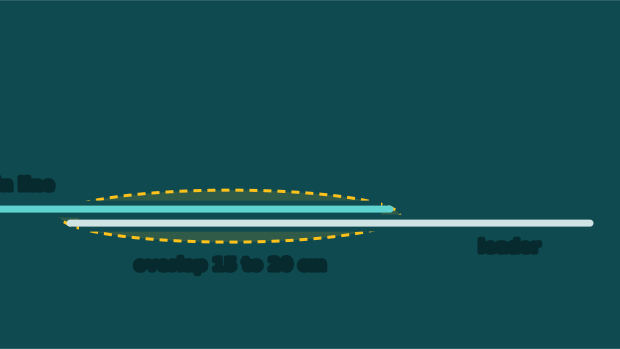
Lay the main line and the leader side by side, overlapping 15 to 20 cm, with the ends pointing in opposite directions.
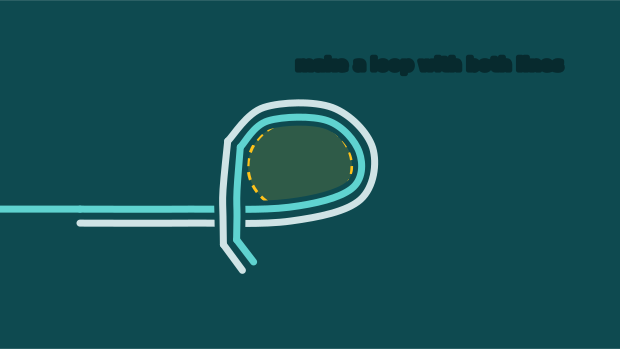
Treat the two lines as one and make a loop.
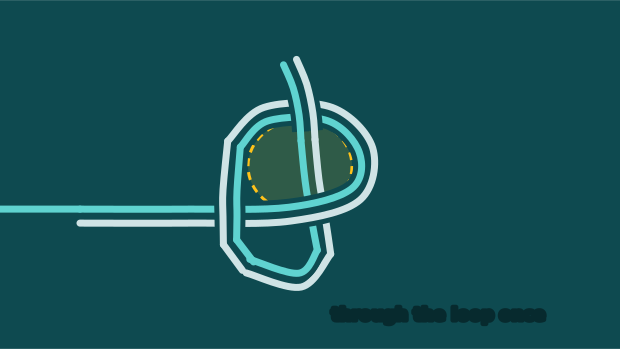
Pass the leader and the main line tag together through the loop, as for an overhand knot.
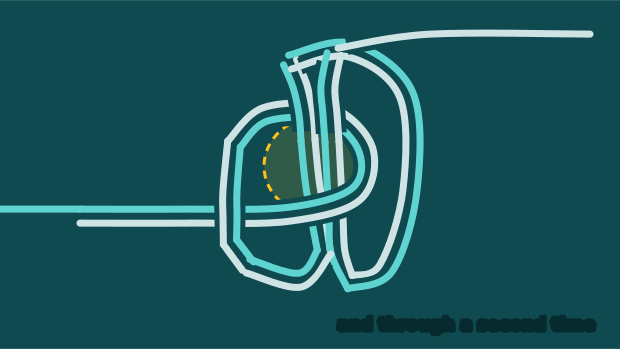
Pass them through the loop a second time.
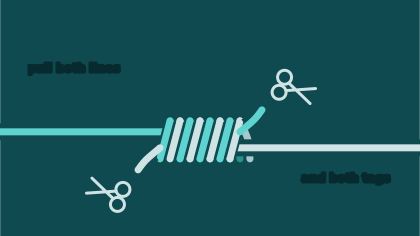
Wet the knot, pull all four ends evenly to tighten, and trim both tags close.
For a triple surgeon's knot, pass through the loop a third time. This is stronger and better for slippery lines like fluorocarbon.
The main drawback: the whole length of the leader must pass through the loop, so it is best with short leaders or when the leader is still on a spool you can pass through.
How to tie a surgeon's loop
- Double the end of the line to form a loop of the size you want.
- Tie an overhand knot with the doubled line.
- Pass the loop through the overhand knot again (making a double).
- Moisten and pull the loop and the standing line to tighten.
- Trim the tag.
Use it to create a quick loop for attaching sinkers or for loop-to-loop connections. For hook droppers on a rig, the dropper loop knot stands out better from the line.
Strength
A well-tied double surgeon's knot keeps about 80 to 90 percent of line strength, the triple a little more. Neat, even tightening matters most.
Tips
- Pull all four ends evenly; uneven tension creates a weak, twisted knot.
- Moisten every time.
- Use the triple with fluorocarbon.
- Trim tags close so they do not catch weed or guides.
Common mistakes
- Not passing the second (or third) turn through the loop.
- Tightening only two ends instead of all four.
- Joining lines of very different diameters; the thin line slips.
On the water in wind and waves, the surgeon's knot is often the knot you can actually tie in a few seconds. Learn it as your backup connection.
Identify your catch with ReelScan: snap one photo to get the species, size and safety notes, and earn points. Scan a fish.
Summary
The surgeon's knot is the fastest way to join two lines of similar diameter. Use the double for most lines, the triple for fluorocarbon, and the surgeon's loop for a quick loop. For long leaders and braid, use slimmer knots, and see the leader length guide to set up your rig.