How to Tie a Non-Slip Loop Knot for More Lure Action
The non-slip (Kreh or Rapala) loop knot: why a loop gives lures more action, how to tie it and which lures need it.
Many lures swim better when they hang on a small open loop instead of a tight knot. The non-slip loop knot, also called the Kreh loop or Rapala loop, creates a fixed loop at the lure eye that does not close under pressure. This gives minnows, jerkbaits, swimbaits and flies freer, more natural action. This guide explains when to use it and how to tie it step by step.
Why a loop knot improves action
A tight knot pins the lure to the leader, especially with stiff fluorocarbon or heavy mono. The leader then acts like a lever and limits how the lure moves. A loop lets the lure swing, wobble and dart freely, which often means more strikes.
When to use the non-slip loop
- Minnow plugs and jerkbaits for seabass, snook and trevally.
- Soft plastic swimbaits on jig heads.
- Bucktail jigs and flies.
- Heavy leaders with small lures, where a tight knot kills the action.
For heavy jigs and big topwater lures attached with split rings and solid rings, a tight knot is fine. See split rings and solid rings.
How to tie the non-slip loop knot
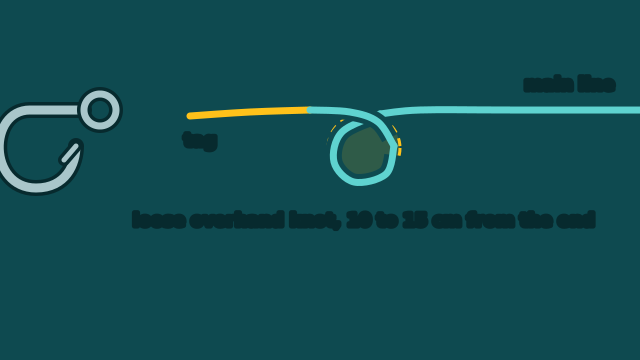
Tie a loose overhand knot in the line about 10 to 15 cm from the end. Do not tighten it.
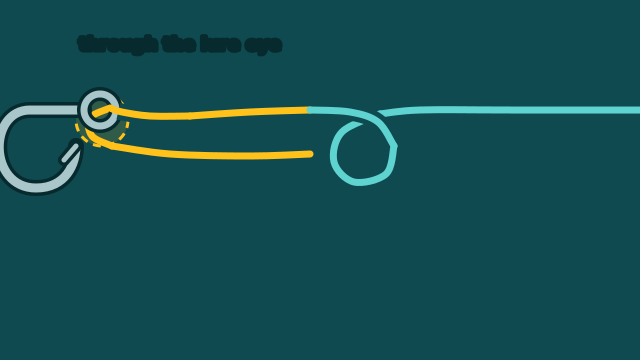
Pass the tag end through the eye of the lure.
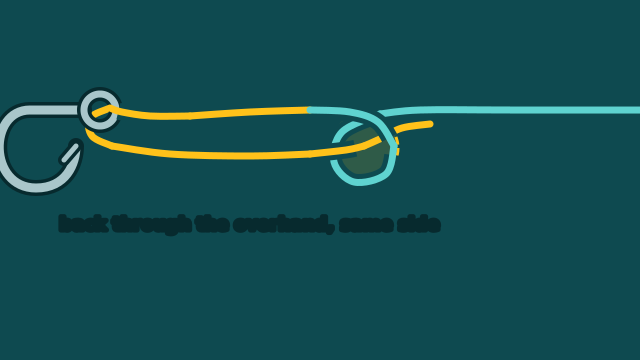
Bring the tag back through the overhand knot, entering from the same side it came out. Slide the overhand to set a 5 to 10 mm loop.
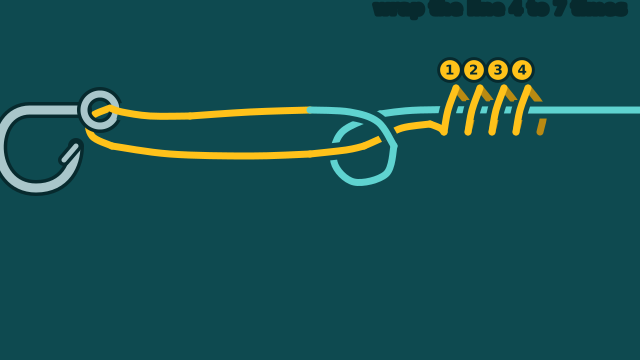
Wrap the tag around the main line: 7 wraps up to 8 lb, 5 for 10 to 14 lb, 4 for 15 to 40 lb, 3 above that.
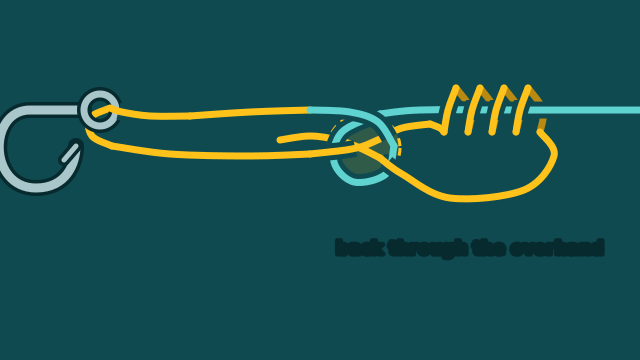
Pass the tag back through the overhand knot, entering from the same side it came out.
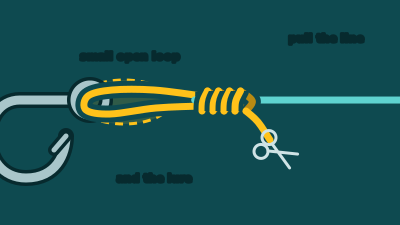
Wet it, pull the tag to bed the wraps, then pull the line and the lure to seat it. Trim the tag.
Wrap count by line strength: up to 8 lb, 7 wraps; 10 to 14 lb, 5 wraps; 15 to 40 lb, 4 wraps; 50 lb and up, 3 wraps.
Tips
- Keep the loop small. A large loop can tangle with hooks.
- Check the loop size before tightening completely.
- Moisten to avoid friction damage.
Loop knot vs snap
A snap also gives lures freedom to move but adds hardware that flashes and can open under a big fish. The non-slip loop is lighter, stronger and less visible. See fishing swivels and snaps.
Common mistakes
- Passing the tag back through the overhand knot from the wrong side, which makes the knot collapse.
- Too few wraps on light line.
- A loop so large it fouls the front hook.
If a lure suddenly swims poorly, look at the knot. A loop that has closed or a knot that has slipped onto the side of the eye ruins the action.
Identify your catch with ReelScan: snap one photo to get the species, size and safety notes, and earn points. Scan a fish.
Summary
The non-slip loop knot gives lures freedom to swim naturally, holds strongly and replaces a snap. Use it with minnows, swimbaits, bucktails and flies, keep the loop small, and adjust the number of wraps to your line strength. Try it in your next session of inshore lure fishing.