How to Tie the Orvis Knot: Small, Strong and Simple
The Orvis knot step by step: a figure eight and two turns through the upper loop make a small, strong knot for hooks, flies and swivels.
The Orvis knot is a small, strong knot for tying a hook, fly, swivel or small lure to mono or fluorocarbon. It was chosen by the Orvis company in an open contest to find a simple, strong terminal knot, and it has kept its place ever since. The knot is built as a figure eight, then the tag takes two turns through the upper loop of the eight. The result is compact, easy to check, and noticeably stronger than many quick knots of the same size.
When to use the Orvis knot
- Small and medium hooks on mono and fluorocarbon leaders.
- Flies, where a small knot keeps the fly swimming naturally.
- Swivels and snaps on light to medium rigs.
- When you want a small knot that is still very strong.
For very small hooks and fast fly changes, the Davy knot is even smaller. For braid, the Palomar knot is usually the better choice. For a classic strong knot in fluorocarbon, compare it with the Trilene knot.
How to tie the Orvis knot
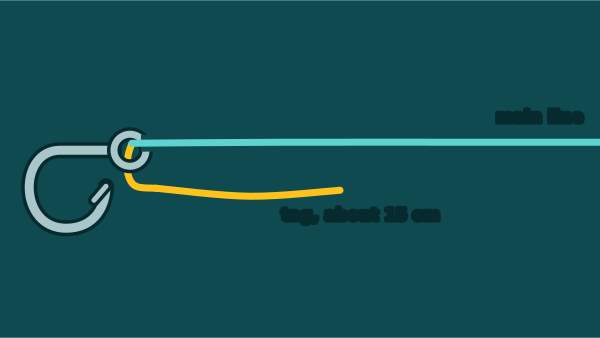
Pass about 15 cm of tag through the eye of the hook, fly or swivel.
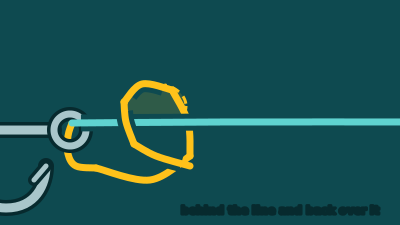
Take the tag behind the standing line and back over it to make a figure eight: one loop below the line by the eye, one above it.
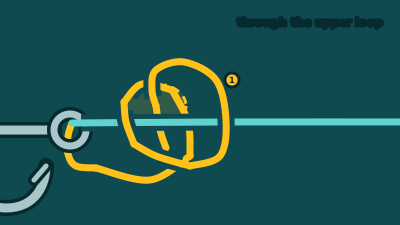
Take the tag round and through the upper loop of the eight.
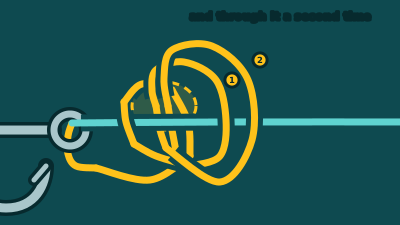
Take it round and through the upper loop a second time, beside the first turn.
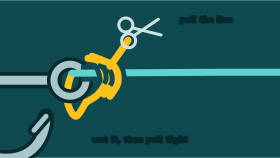
Wet it, pull the tag and the line together to tighten, and trim the tag.
How the figure eight works
After the tag goes through the eye, take it behind the standing line and bring it back over it. This makes a figure eight: one small loop below the line next to the eye, and one loop above the line. The two turns that follow both go through the upper loop of the eight, side by side. When you pull the knot tight, those turns bed down against each other and lock the tag.
If the knot slips when you test it, the most likely cause is that one of the turns went through the lower loop instead of the upper one. Tie it slowly the first few times and watch the path.
Seating the knot
Wet the knot. Pull the tag and the main line together, gently at first, so the turns slide down in order. Then pull the main line firmly while holding the hook. The finished knot is small and sits neatly against the eye. Trim the tag to 2 to 3 mm.
How strong is the Orvis knot?
When tied neatly and seated slowly, the Orvis knot holds very well in mono and fluorocarbon, often comparable to the improved clinch knot while being smaller. As with every knot, how carefully you seat it matters more than which knot you choose. A rushed, dry knot is weak whatever its name.
Orvis knot vs other small knots
- Davy knot: the smallest and fastest, slightly less grip.
- Orvis knot: small, with two locking turns; a good balance of size and strength.
- Improved clinch knot: familiar and strong, but bulkier; see the improved clinch knot.
- Trilene knot: bulkier again, with a double turn through the eye for extra protection.
Line types
The Orvis knot is best in monofilament and fluorocarbon from light tippet up to about 25 lb. In very heavy leader, the turns become hard to seat. In braid, the knot can slip unless extra care is taken; use a leader or choose the Palomar knot.
Tips
- Leave about 15 cm of tag to make the turns easily.
- Keep both turns in the upper loop, side by side.
- Wet the knot before you tighten it.
- Seat it slowly, then give a firm test pull.
- Retie if the knot looks twisted or the line near the eye is scuffed.
Common mistakes
- Taking the tag in front of the standing line instead of behind it, so no figure eight forms.
- Passing a turn through the lower loop.
- Pulling only the tag, which leaves the knot loose.
- Using it in thick leader, where it will not bed down.
The Orvis knot is a great "second knot" to learn after the clinch. It is small enough for flies and small hooks, and strong enough to trust on good fish.
Identify your catch with ReelScan: snap one photo to get the species, size and safety notes, and earn points. Scan a fish.
Summary
The Orvis knot is a figure eight with two turns through the upper loop. It is small, strong and quick to tie, which makes it a good choice for hooks, flies and swivels on mono and fluorocarbon. Pass the tag through the eye, behind the line and back over it, take two turns through the upper loop, wet it and pull it down slowly.