How to Tie the Davy Knot: The Smallest, Fastest Hook Knot
Tie the Davy knot in seconds: a tiny, strong knot for hooks, flies and small lures on mono and fluorocarbon, with the double Davy for extra grip.
The Davy knot is the smallest and fastest hook knot most anglers will ever learn. It was made popular by fly fishers who wanted a knot they could tie in seconds with cold fingers, and it has since earned a place in saltwater fishing for small hooks, jigs and flies on fine mono and fluorocarbon. It uses very little line, leaves a tiny, neat knot at the eye, and once you have learned it you can tie it without looking. This guide shows how to tie it, when it is the right knot, and when you should step up to the double Davy knot or a larger knot.
When to use the Davy knot
- Small hooks, flies and micro jigs where a bulky knot would spoil the presentation.
- Fine tippet and light leaders, roughly 2 to 15 lb, in mono or fluorocarbon.
- Light rock fishing and other finesse styles, covered in the light rock fishing guide.
- Saltwater fly fishing for species such as bonefish and permit, where you change flies often and want to waste as little tippet as possible.
- When you need speed, for example when fish are feeding and every minute counts.
It is not a knot for heavy line or big game. In thick line the half hitches will not bed down properly, and for strong fish a bigger knot such as the improved clinch knot or the Palomar knot is safer.
How to tie the Davy knot
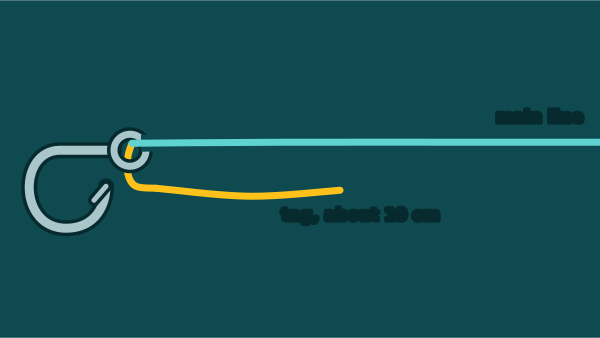
Pass about 10 cm of tag end through the eye of the hook or fly.
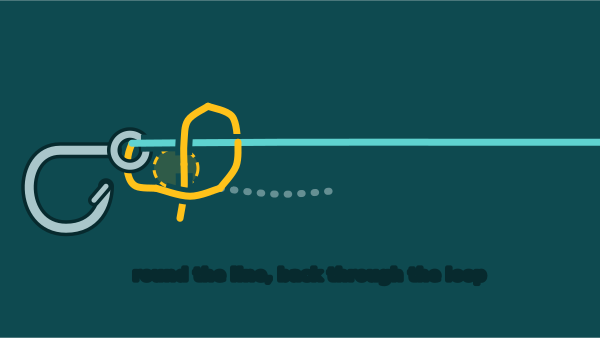
Take the tag around behind the main line, then pass it down through the loop between the line and the eye. This is a half hitch.
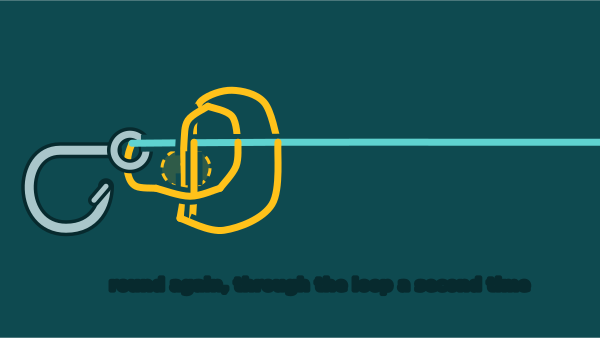
Take the tag around once more and pass it through the same loop a second time, right beside the first pass.
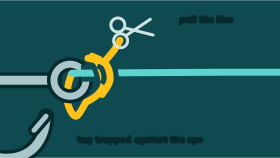
Wet it, pull the main line so the knot jams against the eye with the tag trapped under it, and trim the tag.
How the Davy knot works
The Davy knot is essentially two half hitches tied with the tag around the main line, close to the eye. When you pull the main line, the hitches slide down and jam against the eye, and the tag is trapped underneath them. Because the knot is so short, there is very little line in it to stretch or slip, and it sits almost flush with the eye.
The key detail is the direction of the pass. After the tag goes through the eye, take it around behind the main line, then down through the small loop that forms between the main line and the eye. Both passes go through that same loop, side by side. If the second pass goes through a different opening, the knot will look similar but will not lock.
How much tag to leave
One of the Davy knot's big advantages is that it needs only about 10 cm of tag. With a long tag the knot is no stronger, just harder to manage. This is why fly anglers love it: they can change flies many times before the tippet is too short and has to be replaced.
Seating the knot
Wet the knot, then hold the tag lightly and pull the main line. You should see the two hitches slide down the line and snug up against the eye with the tag tucked under them. Give it a firm test pull. Trim the tag close, but not flush; leaving 1 to 2 mm helps if the knot settles a little the first time it is loaded.
Davy knot vs double Davy knot
The double Davy adds one more pass through the same loop. That extra pass gives more grip, which helps with slippery fluorocarbon and with slightly heavier tippet. It takes a few seconds longer and is a little bigger, but it is still a very small knot. A simple rule:
- Mono and light tippet: Davy knot.
- Fluorocarbon, or tippet over about 8 lb: double Davy knot.
Davy knot vs other small knots
- Improved clinch knot: more familiar and a bit stronger in mid-weight line, but bigger and uses more tippet.
- Trilene knot: stronger again thanks to the double turn through the eye, but bulkier; see the Trilene knot.
- Davy knot: the smallest and fastest; ideal when presentation and speed matter more than maximum strength.
Tips
- Practise it at home with thicker line first, so you can see the path clearly.
- Wet it every time, even though it is small.
- Check the knot after every fish; small knots are only strong when they are fully seated.
- Use the double Davy with fluorocarbon.
- Retie whenever the tippet looks frayed or curly near the eye.
Common mistakes
- Taking the tag in front of the main line instead of behind it.
- Passing the second hitch through a different opening.
- Pulling the tag instead of the main line to tighten.
- Using it on heavy line, where it cannot bed down.
Learn the Davy knot and you will rarely use anything else on small hooks and flies. It is the knot you can tie in the time it takes to unhook a fish.
Identify your catch with ReelScan: snap one photo to get the species, size and safety notes, and earn points. Scan a fish.
Summary
The Davy knot is two half hitches around the main line next to the eye, tied with a short tag and pulled down tight. It is tiny, fast and uses almost no line, which makes it ideal for small hooks, flies and fine tippet. For fluorocarbon or a little more security, add a third pass and tie the double Davy knot.