How to Tie a Blood Knot: Join Two Lines of Similar Size
The blood (barrel) knot joins two lines of similar diameter into a slim, straight connection: step by step, strength, and when another knot is better.
The blood knot, also called the barrel knot, is a classic way to join two lines of similar thickness. It forms a slim, symmetrical barrel of wraps with the two tags leaving from the middle, and it pulls the lines into a straight line rather than bending them. That makes it a favourite for building tapered leaders, adding a length of fresh line to a worn one, and joining mono to mono or fluorocarbon to fluorocarbon. It is a little fiddly at first, but once you have tied it a few times it becomes quick and very neat.
When to use the blood knot
- Joining two lines of similar diameter, for example 20 lb to 25 lb mono.
- Building a tapered leader from several sections of different breaking strain.
- Repairing a main line or adding a top shot of fresh line.
- When the knot must pass smoothly through rod guides, since it is slim and straight.
It is not the best choice for lines of very different diameters, or for braid joined to a leader. For a thin line to a much thicker one, use the Albright knot. For braid to a mono or fluorocarbon leader, the FG knot or double uni knot is easier and more reliable.
How to tie the blood knot
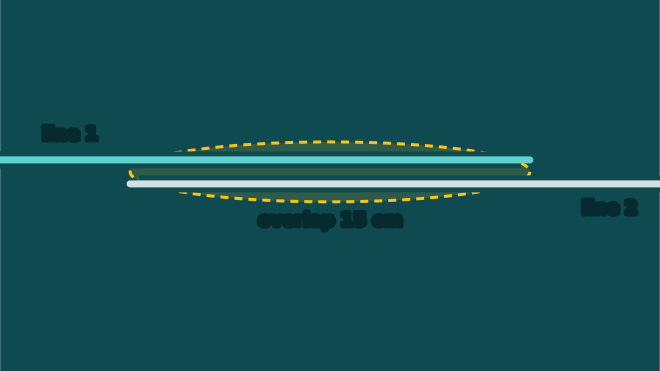
Lay the two lines side by side, overlapping by about 15 cm, tags pointing in opposite directions.
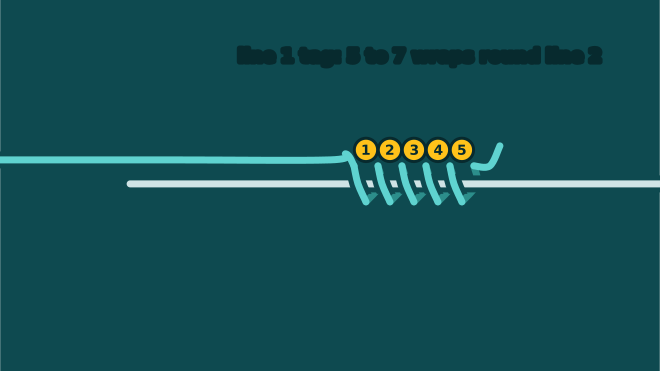
Wrap the tag of line 1 around line 2 five to seven times.
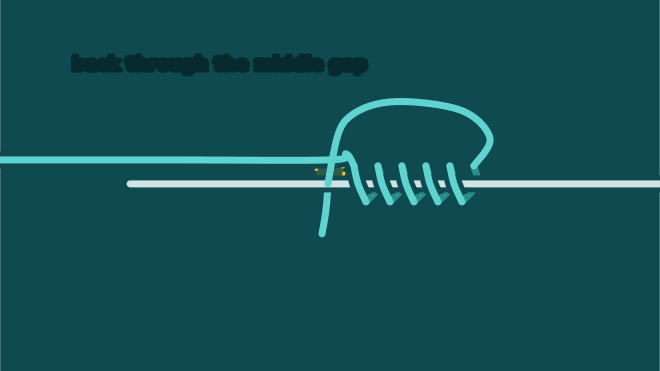
Bring that tag back and pass it through the gap where the two lines cross in the middle.
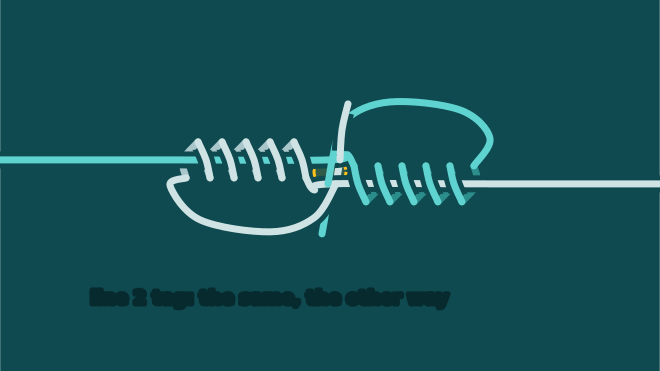
Wrap the tag of line 2 around line 1 the same number of times in the other direction, and pass it through the same gap from the opposite side.
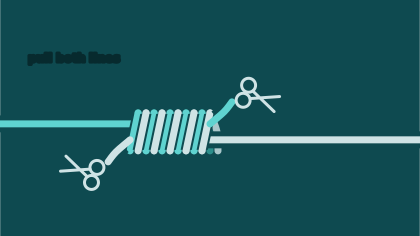
Wet the knot, pull both main lines slowly apart until the wraps bed down, and trim both tags close.
Understanding the shape
The blood knot is two sets of wraps, one from each line, that meet at a central crossing point. Each tag is wrapped around the other line, then brought back and passed through the gap in the middle where the two lines cross. The tags go through that gap in opposite directions: one enters from the top, the other from the bottom. When you pull the lines apart, the two barrels of wraps slide towards each other and lock, with the tags poking out of the centre.
The hardest part for beginners is holding the first set of wraps while making the second. Pinch the crossing point firmly between finger and thumb. Some anglers make the central gap a little bigger by keeping a toothpick or the tip of a needle in it while wrapping.
How many wraps
- Fine line (up to about 12 lb): 6 to 7 wraps each side.
- Medium line (12 to 30 lb): 5 to 6 wraps each side.
- Heavier line (30 to 50 lb): 4 to 5 wraps each side.
Use the same number of wraps on both sides so the barrel is even. Heavier line needs fewer wraps, because thick wraps will not seat if there are too many.
Seating the knot
Wet the knot thoroughly. Pull the two main lines slowly apart, and watch the wraps coil down into a neat barrel. If the wraps overlap or one side seats before the other, cut it off and tie it again; an untidy blood knot is a weak one. When it is seated, give a firm test pull and trim both tags close.
Blood knot vs other line-to-line knots
- Blood knot: slim and straight; best for similar diameters and tapered leaders.
- Double uni knot: easier to tie, works well with braid and for slightly different diameters.
- Surgeon's knot: the fastest to tie on the water, but bulkier and the leader must be passed through the loop.
- Albright knot: best for very different diameters.
Building a tapered leader
A tapered leader starts heavy near the main line and gets lighter towards the hook or fly. This helps the leader turn over cleanly when casting and puts the weakest point near the fish, not at the reel. Join each section with a blood knot, keep the sections roughly similar in diameter step to step, and see the leader length guide for lengths.
Tips
- Overlap generously, about 15 cm, so you have room for the wraps.
- Keep the wraps tight and side by side.
- Use the same wrap count on both sides.
- Wet it every time before pulling.
- Trim close so the tags do not catch in the guides or pick up weed.
Common mistakes
- Passing both tags through the gap in the same direction.
- Letting go of the crossing point, so the first wraps unwind.
- Using too many wraps in heavy line.
- Joining lines that are too different in diameter.
A well-tied blood knot looks like a small, perfect barrel. If yours does not, retie it; it only takes a minute.
Identify your catch with ReelScan: snap one photo to get the species, size and safety notes, and earn points. Scan a fish.
Summary
The blood knot joins two lines of similar thickness with a slim, symmetrical barrel of wraps. Overlap the lines, wrap each tag around the other line, pass both tags through the central gap in opposite directions, wet it and pull slowly. For different diameters or braid, choose the Albright, FG or double uni knot instead.