How to Tie the Egg Loop Knot: Hold Soft Bait on the Hook
The egg loop (bumper) knot step by step: a snell-style knot with a loop that grips roe, soft bait or a bait band against the shank.
The egg loop knot, also called the bumper knot, is a snell-style knot with a useful extra: a small loop of line under the wraps that can be opened to hold soft bait against the shank. It was developed for fishing with clusters of fish roe, but it works just as well for holding soft baits, strips and bait bands. Like the snell knot, it makes the line pull straight off the shank, which improves hook sets with bait.
When to use the egg loop knot
- Soft baits that tear easily, such as roe, soft crab, prawn pieces and squid strips.
- Bait bands and small sponges that need to sit tight against the shank.
- Bait fishing with long-shank hooks, where the wraps have plenty of room.
- Circle and octopus hooks for bait, where a snell-style pull helps the point turn into the jaw.
For general bait fishing where you do not need the loop, a plain snell knot is quicker. For live bait, where the bait must swim freely, a simple knot through the eye is usually better; see the live bait fishing guide.
How to tie the egg loop knot
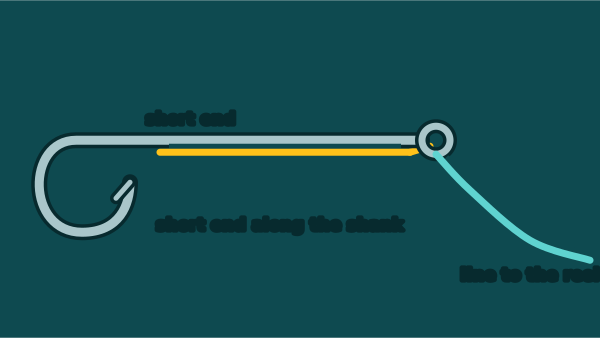
Pass the line through the eye and lay a short end along the shank toward the bend.
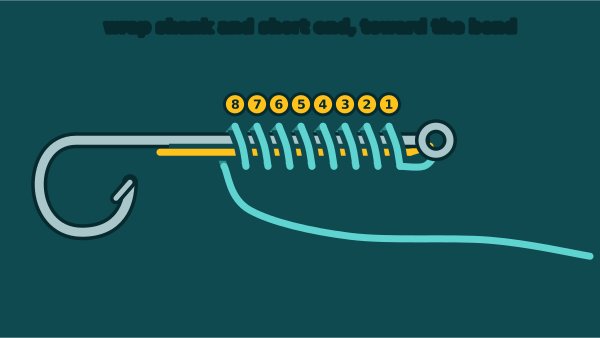
Wrap the long end around the shank and the short end 10 to 15 times, working toward the bend.
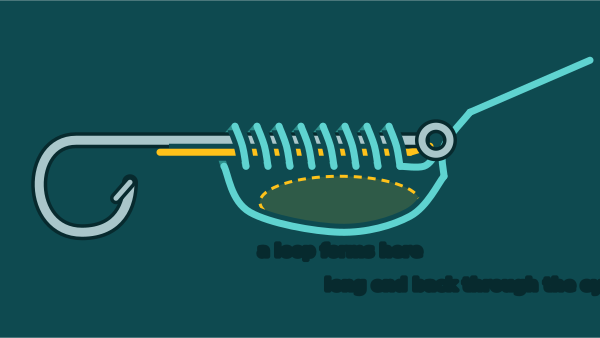
Take the long end back through the eye from the bend side, leaving a loop under the shank.
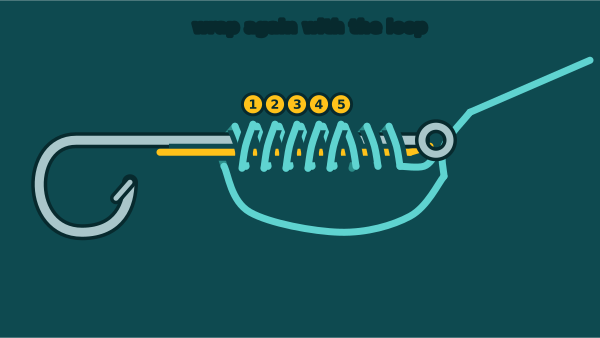
Use the loop to make about 7 more wraps over the first ones, back toward the eye.
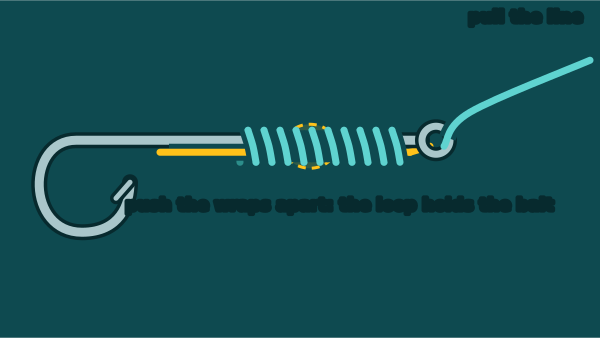
Pull the line to tighten. Pushing the wraps back opens a loop that grips roe or soft bait.
How the loop works
The first set of wraps is made with the long end of the line around the shank and the short end, just like a snell. The long end is then taken back through the eye from the bend side, which leaves a loop hanging under the shank. More wraps are made with that loop, back toward the eye, over the first wraps. When the line is pulled, everything tightens down onto the shank. Later, pushing the wraps back along the shank opens a small loop between them and the shank. Bait pushed into that loop is gripped firmly.
Using the loop for bait
- Push the wraps gently toward the bend with a fingernail to open the loop.
- Slip roe, a soft bait or a bait band into the loop.
- Pull the line: the loop closes and pins the bait against the shank.
This keeps soft bait on the hook during the cast and makes it much harder for small fish to pick it off.
How many wraps
- First wraps: 10 to 15, depending on hook size.
- Second wraps with the loop: about 7.
Smaller hooks need fewer wraps; long-shank hooks can take more. Keep each wrap tight and beside the last, with no overlaps.
Seating the knot
Hold the wraps in place with a finger and pull the line slowly. The loop shrinks and the second set of wraps beds down over the first. Wet the knot first; the many wraps create a lot of friction. Test it with a firm pull. There is no tag to trim beyond the short end, which can be cut close.
Choosing the hook
The egg loop works on most bait hooks with a turned or straight eye, but it is easiest on octopus and circle hooks with a medium to long shank. See circle hooks vs J hooks and types of fishing hooks for how to choose.
Tips
- Keep the wraps neat and tight.
- Wet the knot before pulling.
- Thread the line from the point side of the eye so it pulls straight off the shank.
- Open the loop only when baiting, then pull it closed.
- Tie a few at home and keep them ready on a rig board.
Common mistakes
- Taking the long end back through the eye from the wrong side.
- Making the second wraps loosely, so the loop will not close.
- Using too many wraps on a small hook.
- Pulling it tight dry.
On a day when small fish keep stealing soft bait, an egg loop can be the difference between baits that last one cast and baits that last ten.
Identify your catch with ReelScan: snap one photo to get the species, size and safety notes, and earn points. Scan a fish.
Summary
The egg loop knot is a snell with a built-in bait loop. Lay the short end along the shank, wrap it 10 to 15 times, pass the long end back through the eye to form a loop, make about 7 more wraps with it, and pull. Open the wraps to hold roe or soft bait tight against the shank.